


Maize Mechanized Harvest Loss Reduction Technology
Maize mechanized harvest loss reduction technical guidance
This technical guidance is applicable to corn mechanized ear picking/grain harvesting operations. In a certain area, corn varieties and planting patterns, row spacing should be as standardized as possible, crop plot conditions suitable for mechanized harvest. The appropriate harvest period shall be confirmed in advance, the appropriate harvest method and model shall be selected, the inspection and commissioning of machines and tools and the preparation of plots shall be done in advance, the parameters of machines and tools shall be adjusted according to the trial harvest effect, the harvest driving operation shall be standardized, and the harvest process shall be dried and stored in time to reduce the loss of harvest links.
1. to determine the appropriate harvest period
(I) normal harvest period
Corn harvest can increase grain weight, reduce losses, improve yield and quality, too early or too late harvest will have a negative impact on the yield and quality of corn. The signs of maize maturity are the yellowing of the middle and lower leaves of the plant, the drying of the basal leaves, the yellowing of the ear, the drying of the bracts, the disappearance of the dry and hard milk line, the disappearance of the grain dehydration, the depression of the micro-drying, the black cap layer at the base of the grain (the lower end of the embryo), and the inherent color of the variety. The harvest time of corn varies with variety, sowing date and production purpose.
(II) Special Plot Harvest Period
Harvesting lodged corn and corn in wetland blocks should be based on weather conditions, disaster conditions and the sowing time of the next crop, according to local conditions. In case the rainy season is approaching, or the varieties are easy to drop grains, fold stalks, drop ears, sprouts on ears, etc., they should be harvested in advance.
2. harvesting methods and suitable models
should choose the corn harvester corresponding to the corn planting row spacing, maturity and suitable harvesting method. Select the matching harvester header according to the corn planting row spacing. The deviation between the planting row spacing and the cutting row center shall be within ± 5cm when harvesting less than 6 rows, and the deviation between the planting row spacing and the cutting row center shall be within ± 3cm when harvesting 6 rows or more. Different harvesting methods and conditions, suitable models are as follows:
(I) harvest corn ears
For plots with medium and late ripening varieties and late sowing and late ripening, when the moisture content of corn grains is above 25%, the harvesting methods of mechanical ear picking and peeling, drying sticks in the drying field or drying the whole ear should be adopted. When the moisture content of corn grains in the ear drops below 25% or the outdoor temperature in the northeast region drops to -10 ℃ during the day, mechanical threshing should be adopted.
(II) Harvest Corn Kernels
For plots planted with early maturing varieties, when the grain moisture content drops below 25% or the outdoor temperature in the northeast region drops to -10 ℃ during the day, the corn grain combine harvester can be used to directly thresh and harvest, thus reducing the cost of drying and threshing.
(III) Harvest Lodging Corn
should choose the corn harvester with long header length, small inclination angle and the tip of the divider can stick to the ground. It can also lengthen the tip of the divider on the header of the ordinary corn harvester or install a lodging and supporting device to increase the working stroke of the supporting grain. When the corn lodging inclination angle is greater than 60 °, the harvester header is equipped with chain auxiliary feeding, spiral blade type auxiliary feeding and finger type auxiliary feeding devices to improve the fluency of lodging corn feeding.
(IV) harvested wetland block corn
Crawler-type corn harvester should be adopted; if conditions are not met, other harvesting machinery can also be modified to achieve corn harvest. For example, the wheeled corn harvester is transformed into a semi-crawler corn harvester to increase the grounding area; the crawler grain combine harvester can also be used to adjust the working parameters such as drum speed and concave plate clearance by replacing the special header for corn to achieve emergency harvest.
3. operation
Corn harvester should be fully maintained and debugged before operation, so that the machines and tools can reach the best working condition, prevent and reduce failures in operation, and improve harvest quality and efficiency.
(I) machines and tools
operation season, a comprehensive inspection and maintenance of the corn harvester shall be carried out according to the product instruction manual to ensure that the machinery can work normally during the whole harvest period. After disassembly, maintenance or repair, the corn harvester should be carefully put into trial operation, and the operation, transmission and clearance of the walking, steering, header, conveying, peeling, threshing, cleaning, grain unloading and other mechanisms should be carefully checked. Before operation, check whether the functions of each control device are normal; Check the installation of bearings and high-speed rotating parts (such as stalk chopping device and intermediate shaft) on each part; Whether the free stroke of clutch and brake pedal is appropriate; Whether the fuel, engine oil, lubricating oil and coolant are appropriate; Whether the indications on the instrument panel are normal; Whether the tire pressure is normal; Whether the V-belt, chain, tension wheel, etc. are loose or damaged, and whether the movement is flexible and reliable; check and adjust the tension of each transmission belt to prevent the belt from slipping during operation; whether the bolts and nuts in important parts are loose; whether there is water leakage, oil leakage, etc.; whether all protective covers are fastened, check the windows, seals, and metal baffles Whether the parts are closed and completely sealed. Prepare the common tools and vulnerable parts for field operation, so that the failure can be eliminated in time. No-load test run, check the working condition of the hydraulic system, the sealing condition of the hydraulic pipeline and hydraulic parts; check whether the bearing is overheated, the transmission condition of the belt and chain, and the fastening condition of the connecting parts.
(II) field preparation
Before entering the plot for harvest, the corn harvester must first understand the basic situation of the plot, including corn varieties, planting row spacing, density, maturity, yield level, minimum ear height, ear drooping and stem lodging, and field obstacles, etc., and make an operation plan in advance.
operation, the ditches, ridges and passageways in the plot shall be leveled, and inconspicuous obstacles such as wells, electric poles and tree stumps shall be marked to facilitate safe operation. For plots with serious water accumulation in the field and short-term inability to drain, ditches should be dug to drain the water in the field; for plots with general water accumulation, ditches should be dredged to drain the water, and deep ditches should be excavated to drain the water.
4. trial acceptance
Before the formal harvest operation, select representative plots for trial harvest, check the quality of trial harvest operation, and adjust the machine parameters according to the operation quality.
(I) ground trial collection operation
harvester enters the field, engage the power gear and let the machine run slowly. After confirming that there is no abnormality, press down the hydraulic control handle of the header, lower the header to a suitable position (make the front part of the ear picking plate or ear picking roller 30-50cm below the corn ear cutting position), slowly engage the main clutch, and make each mechanism run. If there is no abnormality, the engine speed can be increased to the rated speed; after each mechanism runs smoothly, move forward in low gear. First of all, the parameter settings recommend in the operating instructions of the harvester shall be adopted for trial harvesting. The normal operating speed shall be adopted for trial harvesting of 30-50m to stop the machine. The fruit ear, grain loss, breakage, impurity content, etc. shall be checked to confirm whether there are any abnormal conditions such as missing cutting and blockage, and the machines and tools and operating parameters shall be adjusted as required.
(II) inspection trial acceptance quality
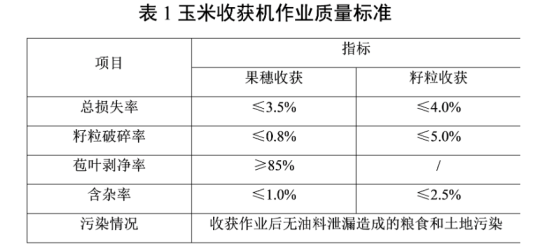
examines the loss, the type of loss and the cause of the loss should be clarified. Harvest losses generally include pre-harvest losses, harvester losses, harvester losses are divided into header losses, peeling grain losses, threshing losses, cleaning losses, bracts with grain loss. The types of harvest losses should be identified and then targeted adjustments should be made. In order to reduce the loss of mechanical harvest, the picking roller (or stem pull roller, picking plate), conveying, peeling, threshing, cleaning and other institutions should be adjusted as necessary, and then trial harvest testing should be carried out after adjustment until the harvest quality standard requirements are met (see Table 1).
(III) Machine Parameter Adjustment Method
1. Adjust the working parameters of the roller picking mechanism
For the ear picking mechanism of the ear picking roller type, when the speed of the ear picking roller is too low, the probability of the corn ear being gnawed increases; when the speed of the ear picking roller is higher, the probability of the corn ear being gnawed and falling grain increases. Therefore, the pick roller speed should be reasonably selected. In addition, when the gap of the ear picking roller is too small, the situation of rolling and broken stalks is more serious, and there will be a larger straw can not pass through smoothly and cause blockage; When the gap is too large, the ear will be gnawed and the loss of grain loss will increase. Therefore, the ear picking roller gap should be adjusted according to the characteristics of corn.
should be adjusted to the appropriate speed or gap of the ear picking roller, and the rated speed of the engine should be maintained with a large throttle, so that the ear picking roller is in the appropriate speed range (900-1200r/min). The ear picking roller gap is generally 0.3-0.5 times of the average diameter of the corn stalk to be harvested. The specific adjustment method shall be carried out according to the requirements of the operating instructions of the harvester.
2. Adjust the working parameters of the combined picking mechanism of the stem roller and picking plate.
The correctness of the gap between the two stalk rollers and the two ear picking plates has a great influence on reducing losses and preventing clogging. It must be adjusted in time according to the corn variety, ear size, stem thickness, etc.
(1) The gap between the stem-pulling roller refers to the gap between the convex rib of the stem-pulling roller and the outer circle of the concave surface of another stem-pulling roller; When the gap is too large, the stem is not fully pulled, easy to be blocked, and the ear loss increases. If the gap is too small, the situation of biting off the stem will be severe.is heavy, so a suitable working gap (10-17mm) of the stem roller should be maintained. When the stem is thick, the plant density is large, and the crop moisture content is high, the gap should be appropriately larger, otherwise the gap should be smaller, and the specific adjustment method should be carried out in accordance with the requirements of the harvester instructions.
(2) The clearance of the picking plate is mainly related to the diameter of the stem and the diameter of the fruit spike. The clearance at the front end of the picking plate should be 2/3 of the average diameter of the fruit spike, and the clearance at the back end of the picking plate is 5mm larger than that at the front end. Large throttle should be used to maintain the rated speed of the engine, so that the stem roller is in the appropriate speed range (600-900r/min), the specific adjustment method is in accordance with the requirements of the harvester instruction manual.
3. Adjust the peeling device
The peeling device of the ear picking and peeling type corn harvester should adjust the appropriate distance between the pressure feeder and the peeling roller according to the state of the ear to be harvested, which should be slightly smaller than the diameter of the corn ear, so that the ear and the peeling roller maintain appropriate friction and improve the peeling rate. The inclination angle of peeling roller is generally 10 °-12 °, and appropriate inclination angle can reduce ear damage and grain drop. The specific adjustment method shall be in accordance with the requirements of the operating instructions of the harvester.
4. Adjust working parts such as threshing and cleaning
corn grain is harvested, on the premise of ensuring that the crushing rate meets the requirements, the removal rate can be improved by appropriately increasing the rotation speed of the threshing drum and reducing the gap between the drum and the concave plate. On the premise of ensuring that the impurity content meets the requirements, the cleaning loss can be reduced by appropriately reducing the fan rotation speed, adjusting the opening of the sieve and increasing the position of the tail sieve. The specific parameter selection and adjustment method are adjusted according to the requirements of the harvester instruction manual.
5. Harvest Operations
(I) reasonably determine the walking route
1. Normal Harvest
harvester is operating, the operator should first understand the general shape, length and width of the plot to be operated and the direction of corn planting to determine the position and direction of travel of the machine, and be sure to ensure that the machine travels in the direction of the corn planting row. When turning, stop harvesting, use reverse turning or clockwise circle turning at right angles, do not turn while reeling, so as to prevent the tiller, walking wheel, etc. from overwhelming the unharvested corn, causing loss of missing cutting and even damage to the machine. Harvesting perpendicular to the planting line should be avoided as much as possible, especially in fields with higher ridges. Harvesting perpendicular to the planting line will cause substantial turbulence of the machine, thus increasing harvesting losses and even causing machine failure.
2. Lodging Corn Harvest
For the corn plants whose lodging direction is parallel to the planting row, it is advisable to adopt the reverse row harvesting method opposite to the lodging direction, and return idling, which is conducive to picking up the lodging corn for harvesting; for the corn plants whose lodging direction is inconsistent, it is advisable to adopt the reciprocating row harvesting operation method. During operation, the front part of the tiller of the harvester should be close to the ground in the furrow, and the power of the straw returning device should be disconnected or the device should be raised to the highest position to prevent the missing corn ears from being broken, so as to facilitate manual picking and reduce harvest losses. During the harvesting operation, the harvesting speed shall be appropriately reduced, and the header shall be cleaned in time to prevent blockage caused by irregular feeding of lodging corn plants, which will affect the operation effect and increase the operation loss.
(II) select job speed
should be based on the theory of corn harvester feeding amount, corn yield, plant density, natural height, dry and wet degree and other factors to reasonably determine the operating speed, generally 4-6 km/h. The forward speed should be synchronized with the rotation speed of the stem pulling roller and the speed of the winding chain to reduce the loss of falling ears of the header. Under normal circumstances, the beginning of the first low-speed harvest, and then appropriately increase the speed of operation, and finally the use of appropriate normal operating speed for harvesting, it is strictly prohibited to pursue efficiency to unilaterally enhance the forward speed. Pay attention to observe whether the picking mechanism and peeling mechanism are blocked during harvest. When the corn is dense, the plant is large, the yield is high, the row spacing is different (the row spacing is irregular), the terrain is fluctuating, the crop humidity is large in the morning and evening and after the rain, the operation speed should be reduced appropriately; When driving at low speed,cannot reduce the engine speed. Sunny days around noon, straw drying, harvester forward speed can choose faster. When corn is over-mature, the stem is too dry and easy to break, and the ear is easy to fall off. After threshing, the increase of broken stem is easy to cause difficulty in separation. When harvesting, the forward speed is appropriately reduced, and harvesting can also be arranged in the morning or evening when the stem toughness is large.
(III)
, under the condition that the load is allowed and the technical condition of the harvester is in good condition, control the operation speed and harvest as full as possible. When the load is large, reduce the harvest line appropriately to ensure the uniform feeding of crops and prevent the excessive feeding amount from affecting the harvest quality. When the corn row spacing is different, it can be dissatisfied with the cutting operation to avoid scratching the adjacent row stalks, resulting in plant folding and ear falling, increasing the loss.
(IV) maintain proper stubble height
shall be determined according to the height of corn, the leveling of the plot and the technical mode of crop planting in the following year (next crop). Generally, the height of stubble shall be less than 10cm, or 30-40cm high stubble can be left, and straw treatment shall be carried out in the later period. In the area where conservation tillage technology is adopted, the height of stubble shall be controlled at 10-25cm as much as possible during harvest, so as to facilitate stubble fixation and form a "wind wall" to prevent wind, reduce surface wind speed and block straw accumulation.
(V) specification driving operation
1. The corn harvester should be operated by professionals or skilled operators with professional training, and master the operation essentials of the harvester to cross obstacles, turn, harvest, walk and unload grain;
2. Harvesting shall be carried out according to the parameters of the machines and tools adjusted during the trial harvest, and the operation quality such as stubble height, harvest loss rate, stripping rate, impurity content rate and crushing rate shall be checked regularly, and the header height, header parameters, peeling device or threshing and cleaning working parts shall be adjusted in time according to the operation quality;
3. Do not stop at will during the operation. If you need to stop, stop the machine first, let the harvester continue to run for about 30 seconds, and then cut off the power to reduce the phenomenon of ear breakage and grain breakage when starting again;
4. During the operation, the operator should observe the operation condition of the harvester at any time to avoid abnormal phenomena such as collision of hard objects by the tiller/ear picking mechanism, leakage of harvest, excessive feeding amount, and soil beating by the hammer claw of the field returning machine.
6. drying and storage
(I) drying
If the moisture content of the harvested corn grain does not meet the storage requirements, it should be dried in time. The harvested corn kernels should be dried by continuous dryer or circulating dryer. The harvested corn ears should be stored off the ground or dried, ventilated and watered, and then thresped and dried after the moisture content of the grain drops below 25% or the ears freeze in winter.
Before drying, initial cleaning shall be carried out. There shall be no long stalks, sack rope, plastic film and other sundries. The corn impurity content shall be less than or equal to 2%. The initial moisture content of corn grains shall be determined, and the moisture unevenness of the same batch of dried corn grains shall be less than or equal to 3%.
drying, the allowable heating temperature of corn is as follows: edible corn ≤ 50 ℃, starch fermentation industrial corn ≤ 55 ℃, feed corn ≤ 60 ℃, and seed corn ≤ 43 ℃. At the same time, the primary precipitation amplitude should be controlled ≤ 18% to reduce the corn crack rate and drying unevenness. After drying, there shall be no obvious change in the color and smell of the corn, and no heat-damaged grains or burnt grains. The drying quality of corn shall meet the requirements of GB/T 21017.
(II) storage
Corn grain should be stored in a warehouse or stored in a warehouse. The ambient temperature in the warehouse is ≤ 20 ℃, the relative humidity of the air is 60%-70%, and the balanced moisture of corn grain is generally less than 14%. Should be based on the local climate barpieces and grain situation, timely ventilation, balance grain temperature and moisture, effectively prevent fever, condensation, moisture absorption and other hidden dangers.
7. training and supervision
(I) to carry out harvest technology training
operators, growers and township agricultural machinery management personnel engaged in harvest quality supervision should be trained to master the knowledge of corn varieties, grain moisture content, planting mode, harvest terrain, etc., and master the correct use of harvesters, maintenance knowledge and operation quality standard requirements.
(II) Strengthen Operation Quality Supervision
Encourage growers and operators to sign an agreement on the loss of harvest operations, agricultural machinery management personnel can supervise the loss of operations through patrol inspection, and in the case of large losses or other non-conforming circumstances, require the operator to adjust the harvester, still not required, should be timely replacement of faulty parts or the whole machine.
